
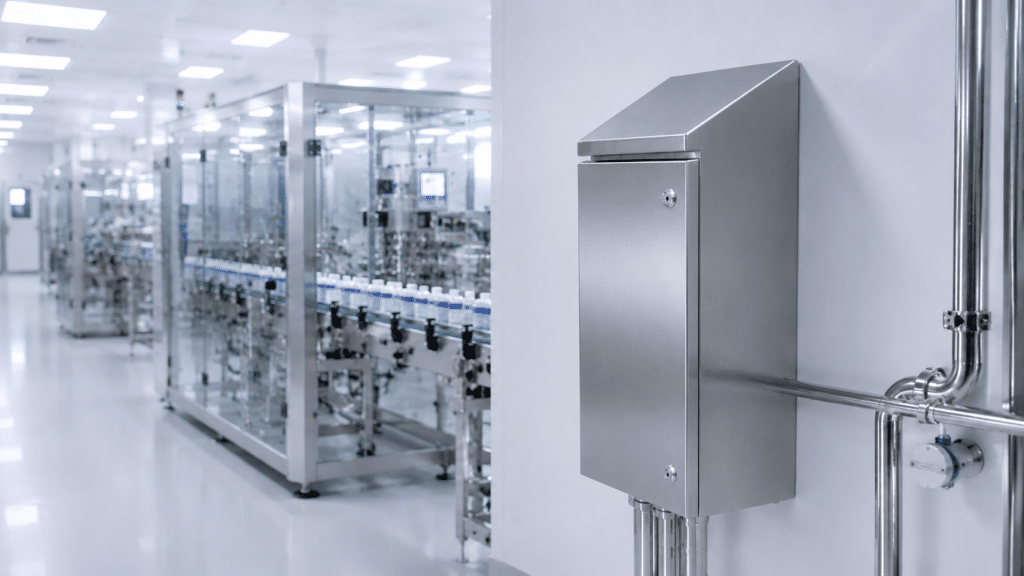
The context: a line expansion in a mid-sized pharmaceutical plant
Here’s the situation: a mid-sized pharmaceutical plant expands one of its packaging lines, located in an area classified as an ISO 7 cleanroom. As in any area of this kind, the installation is subject to a periodic cleaning and disinfection protocol, using specific chemical products and a cleaning frequency far more demanding than that of a conventional industrial building.
For the expansion, a new electrical enclosure is installed next to the line, specified with a technical spec that, on the face of it, looked solid: stainless steel, IP66, correctly sized for the switchgear it would house. The enclosure is installed, commissioned without incident, and the line runs normally for several months.
The problem: the GMP audit flags a non-conformity on a “technically correct” enclosure
The following internal Good Manufacturing Practice (GMP) audit is what uncovers the problem, and it does so in a way that surprises the maintenance team itself: the enclosure doesn’t fail on its IP rating, which does meet the specification, but on its constructive design. The auditor points to two specific issues as non-conformities: the enclosure’s roof is a flat surface, and one of the built-in cable glands has a partially exposed thread at its base.
Neither detail compromises the enclosure’s nominal watertightness. And yet both are exactly the kind of finding a GMP audit is designed to catch, because in a cleanroom it isn’t enough for water to stay out: water and residue must also be prevented from pooling anywhere on the equipment’s outer surface, however small the spot.
The diagnosis: why an IP rating isn’t enough in a cleanroom environment
What this case reveals is a distinction that’s rarely made explicit when specifying an enclosure for a GMP area: the IP rating measures watertightness against water and dust, but it says nothing about whether the enclosure’s geometry makes cleaning its outer surface easier or harder. A flat roof, for instance, does its watertightness job perfectly well while at the same time collecting water and residue with every cleaning cycle, precisely because there’s no slope to encourage runoff. An exposed thread on a cable gland doesn’t necessarily let water into the enclosure, but it does become a spot where surface dirt gets trapped — something a hygiene audit scrutinizes just as rigorously as watertightness.
This is why GMP audits, like HACCP audits in the food industry, assess two distinct and complementary things: the IP protection rating on one hand, and the hygienic design of the assembly on the other. An enclosure can pass the first and fail the second, as happened here, and the result is a non-conformity that no watertightness test would ever have caught.
The solution applied
The fix involved replacing the enclosure with one built to a specific hygienic design: a sloped roof instead of a flat one, to prevent water from pooling on top; flat cable glands and continuous gaskets, with no exposed threads or gaps where residue could collect; and stainless-steel hinges and latches free of blind spots that cleaning couldn’t reach.
As for the material, AISI 316L stainless steel was chosen over the 304L initially considered, given the constant exposure to the disinfectants used in the room’s cleaning protocol. 316L includes molybdenum in its composition, which lets it resist chlorides and chlorinated disinfectants without developing localized corrosion — a risk 304L doesn’t cover with the same reliability when exposure is this frequent.
Self-check checklist
Before signing off on the specification of an electrical enclosure for a cleanroom or pharmaceutical process area, it’s worth reviewing these points, which rarely stand out on a technical datasheet but are exactly what a hygiene audit evaluates:
- Is the enclosure’s roof sloped or flat? A flat roof collects water and residue with every cleaning cycle, regardless of its IP rating.
- Are there exposed threads or visible gaps in the gaskets and cable glands? Any gap that cleaning can’t reach is, in practice, a hygiene risk point.
- Does the material withstand the plant’s actual cleaning and disinfection protocol, not just a generic standard? The frequency and type of chemical used determine whether 304L is enough or 316L is required
- Has the design been validated by the quality team, not just maintenance? An enclosure can be technically correct from an electrical standpoint and still fail a GMP audit if no one reviewed its constructive design from a hygiene perspective.
Frequently asked questions
Does an IP66-rated enclosure already meet the GMP requirements of a cleanroom?
Not necessarily. IP66 certifies watertightness against water and dust, but a GMP audit also evaluates the assembly’s hygienic design: roof geometry, absence of blind spots, and gasket continuity.
What’s the difference between a standard enclosure and a hygienic-design one?
Hygienic design adds a set of specific constructive decisions on top of IP protection: a sloped roof instead of a flat one, flat cable glands with no exposed threads, continuous gaskets, and hinges with no blind spots that cleaning can’t reach.
Is 316L stainless steel mandatory in every pharmaceutical cleanroom?
Not in every case. It depends on chloride exposure and the frequency and aggressiveness of the cleaning and disinfection protocol. Under intensive exposure, 316L is the recommended choice over 304L.
Need to check whether your installation meets hygienic design, not just the IP rating?
At Volthree we assess both the protection rating and the constructive design required by your pharmaceutical or food processing area, to prevent non-conformities that no watertightness test alone can catch.