
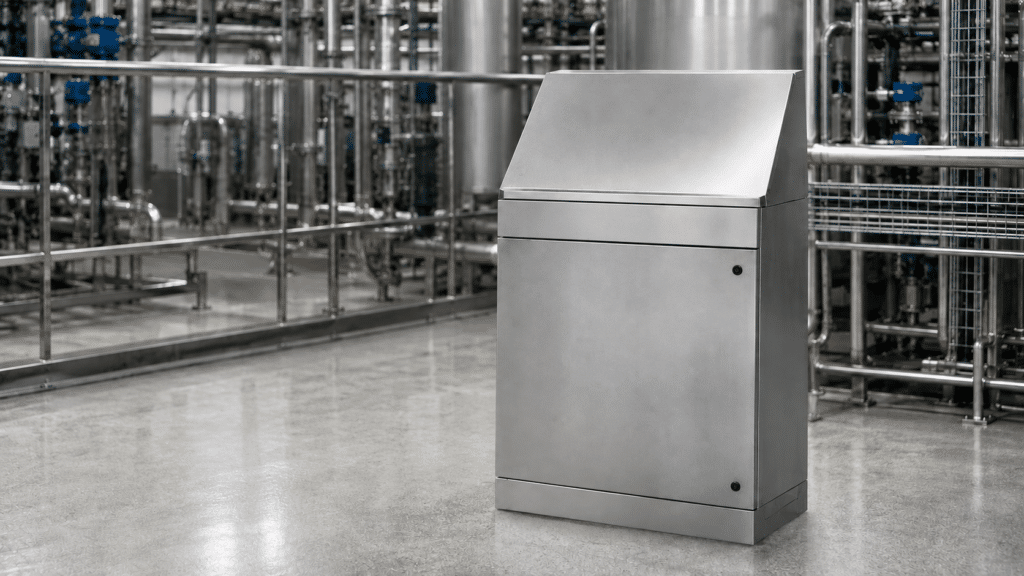
In this guide, we cover exactly what a control desk is, how it differs from a control console, why stainless steel has become the standard for this type of enclosure, and what factors — including ATEX regulations, in some cases — should be settled before requesting a quote.
What is a control desk (and how does it differ from a console)
A control desk is a single-structure enclosure that sits directly on the floor via a support base, with one or two angled top surfaces where the control elements are integrated: pushbuttons, selector switches, operator panels or, in some cases, an industrial computer. It’s the format designed for the operator to work standing up, with the control surface at the right height and angle.
It’s often confused with a control console, another type of operator-interface enclosure, but with a different use: the console is usually mounted suspended or on an adjustable support arm, and is designed mainly to house HMI screens or industrial PCs that need to be angled toward the operator. The control desk, by contrast, is a freestanding structure resting on the floor.
Control Desk vs. Control Console

This distinction isn’t just terminology: requesting a quote with the correct enclosure type specified avoids confusion with the manufacturer and helps ensure the proposed solution actually fits the real workstation.
Why stainless steel is the standard material for control desks
AISI 304L stainless steel control desks have become the standard in installations where the workstation coexists with frequent cleaning protocols, humidity or exposure to chemical agents: food, pharmaceutical, chemical or water treatment industries, among others.
The reason is the same one that applies to any stainless steel electrical enclosure: corrosion resistance doesn’t depend on a surface finish that can degrade over time, but is instead a property of the material itself. In a control desk, this is also combined with a sealed design and a fine satin exterior finish (Scotch Brite–type) that makes cleaning easier and prevents dirt from building up in the seams — a factor that matters especially for an element the operator touches and cleans every day.
Design and customization: what variants are available
Not every control station needs the same configuration. The work surface can be manufactured at different angles depending on how the desk will be operated, and it’s common to combine one or two surfaces on the same structure:
- 70° top surface: a more vertical orientation, designed for frequently used pushbuttons and selector switches.
- 10° top surface: a more horizontal orientation, more comfortable for operator panels or documentation.
- Combination of a 70° surface and a 10° central surface: allows both types of elements to be integrated into the same desk.
Besides the tilt angle, the desk can be customized with one or two internal mounting plates, machined to measure for the specific control elements to be installed, along with a wide range of accessories. This allows the same base structure to be adapted to very different needs without switching to a different product family.
Protection rating: what IP and IK ratings to consider
As with any electrical enclosure, the control desk must be specified with an IP protection rating suited to the environment where it will be installed: IP65 may be sufficient in a standard industrial setting, while in areas with pressure washdowns or high humidity exposure, it’s worth considering IP66 or higher. If there’s also a risk of impacts or vibration — for example, on a line with frequent forklift or mobile machinery traffic — the IK mechanical resistance rating should also be checked, a spec independent of IP that’s often overlooked.
Neither rating replaces the other, and neither replaces choosing the right material either: these are three separate decisions that need to be resolved together when specifying the desk.
When ATEX marking comes into play
In some installations, the control desk is located within a zone classified as a potentially explosive atmosphere — for example, in the presence of solvents or flammable gases in the chemical industry, or combustible dust clouds when handling flour or sugar in the food industry. In these cases, Directive 2014/34/EU requires that any equipment installed in that zone, including the control desk, carry the ATEX marking corresponding to the group, category and atmosphere type of that specific zone.
An important nuance: the ATEX zone of an installation isn’t determined by the desk’s manufacturer or distributor, but by the plant’s own zone classification study, usually carried out by an industrial safety technician. Without that information settled beforehand, it isn’t even possible to determine what type of equipment applies to that location.
If your project includes a classified zone, the most effective approach is to bring it directly to our technical team along with the classification data: that way we can assess with you which options are viable for your specific case, rather than starting from assumptions.
Common mistakes when specifying a control desk
- Requesting a quote without defining the exact control elements: the number and type of pushbuttons, selectors or panels directly determines the machining of the mounting plate.
- Not stating the actual cleaning protocol for the workstation: an environment with frequent pressure washdowns requires a different IP rating and finish than a technical office environment.
- Confusing control desk and console in the request: these are two formats with different installation logic, and starting with the correct term speeds up the entire quoting process.
- Leaving the ATEX zone classification until the end: if the workstation is installed in a classified zone, this needs to be resolved before requesting a quote, not after.
Frequently asked questions about stainless steel control desks
What’s the difference between a control desk and a control console?
A control desk is a freestanding structure that rests on the floor, with one or two angled surfaces for pushbuttons, selectors or operator panels. A console, by contrast, is usually mounted suspended or on a support arm and is designed mainly for HMI screens or industrial PCs.
Do all control desks need to be made of stainless steel?
Not as a general rule, but in environments with intensive cleaning, constant humidity or exposure to chemical agents (food, pharmaceutical, chemical, water treatment), it’s the option that best prevents material deterioration over time.
Is ATEX marking mandatory on a control desk?
Only if the desk is installed within a zone classified as a potentially explosive atmosphere. That classification is determined by the plant’s own zone study, not by the desk manufacturer, and must be resolved before requesting a quote.
What IP rating does a control desk need in a standard industrial environment?
As a reference, IP65 is usually sufficient in an industrial environment without pressure washdowns. In more demanding environments, with constant humidity or intensive cleaning, it’s worth considering IP66 or higher.
At Volthree, we design and manufacture stainless steel control desks, customized according to the control elements of your installation. If your project has specific requirements around environment, protection rating or classified zones, get in touch with our technical team.