
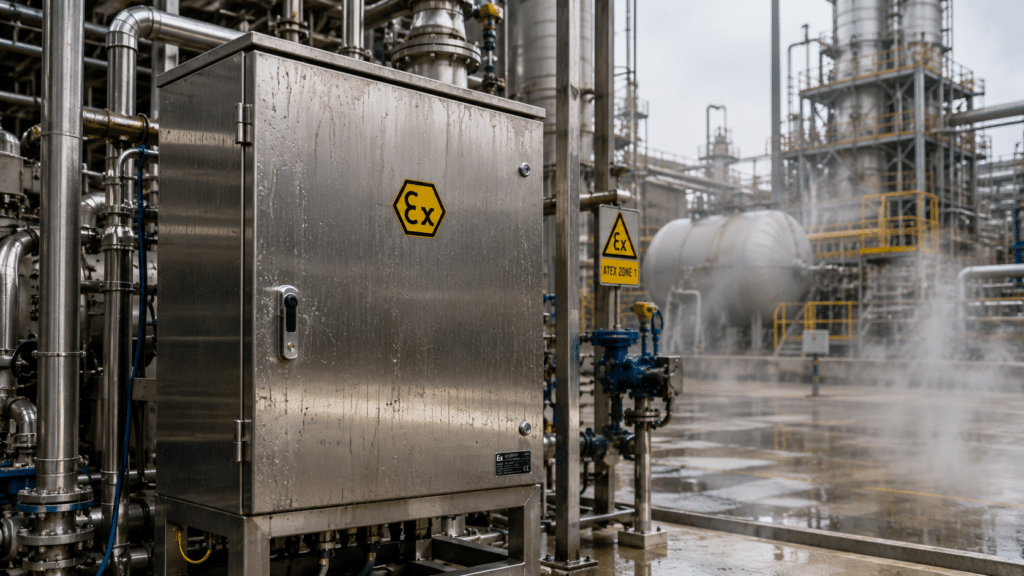
The criterion that changes everything: it’s not cleaning, it’s direct chemical corrosion
A cabinet in a food processing plant degrades through repeated washing cycles with water, heat, and detergents. A cabinet in the chemical industry may be continuously exposed to a specific corrosive agent: an acid, a base, a solvent, a vapor. This difference matters because not all stainless steels behave the same way against all chemical agents, and specifying “stainless steel” without further detail—without identifying the agent present on site—is an incomplete specification.
- AISI 304L: withstands most dilute acids and standard industrial environments well. When exposed to concentrated chlorides or hydrochloric acid, it may develop pitting corrosion over time.
- AISI 316L: contains molybdenum, which significantly improves resistance to chlorides and to a broader range of chemical agents. It is the standard choice when there is regular exposure to chlorides, brines, or coastal environments.
- Higher-grade alloys (duplex, super duplex, high-nickel alloys): required when the chemical agent present is particularly aggressive (concentrated acids, chlorine gas, certain solvents). This decision should not be made by default, but by consulting the safety data sheet (SDS) of the chemical product present at the facility.
Before requesting a quote, the essential piece of information is not “it’s a chemical environment,” but the specific name of the agent and its typical concentration in the area where the cabinet will be installed.
IP rating in the chemical industry: less about pressure, more about vapors and dust
Unlike the food industry, where IP69K is the standard due to pressure washing, in the chemical industry the predominant criterion tends to be protection against corrosive vapors and dust, not necessarily direct washing:

The IK rating (EN 62208) also applies here under the same criteria as in any industrial plant: IK08 as a minimum in areas with forklift traffic or container handling, rising to IK09-IK10 if the impact risk is high.
When ATEX marking is mandatory, not optional
This is the point that most distinguishes the chemical industry from the food industry: the risk of an explosive atmosphere from flammable gases or vapors is much more frequent, and is not limited to isolated points such as flour or sugar handling. If the plant contains flammable solvents, combustible gases, or processes that generate flammable vapors above their flash point, that area must be classified according to an explosion risk area study, and any cabinet installed there must comply with the ATEX Directive 2014/34/EU.
ATEX marking identifies:
- Equipment group: II, for surface equipment (non-mining).
- Category: 2 (high level of protection, for zones where an explosive atmosphere is likely during normal operation) or 3 (normal level, for zones where it is unlikely and of short duration).
- Atmosphere type: G (gases), D (dust), or GD (both).
- Zone: 1 or 21 (likely during normal operation), 2 or 22 (unlikely and of short duration).
This information is not determined by the cabinet manufacturer: it comes from the zone classification study carried out by the plant’s industrial safety department or prevention technician. What the manufacturer must guarantee is that the specific model supplied holds the ATEX certification corresponding to the indicated zone—not a generic “suitable for industrial environments” certification.
The most common mistake: applying one zone’s criteria to the whole plant
In a chemical plant it is common for ATEX-classified zones (for example, next to a reactor or a solvent tank) to coexist with zones without that risk (technical offices, control rooms far from the process). Specifying ATEX marking for every cabinet in the facility as a precaution unnecessarily raises project costs; failing to mark the ones that do require it is a safety and regulatory compliance risk. The only correct way to resolve this is to start from the zone study, cabinet by cabinet, rather than making a blanket decision for the entire project.
Need help defining the right electrical cabinet for your chemical plant?
At Volthree we analyze every line and every zone of your facility to specify the material, protection rating, and ATEX marking that your process actually needs, avoiding overcosts from over-specification and risks from non-compliance.