
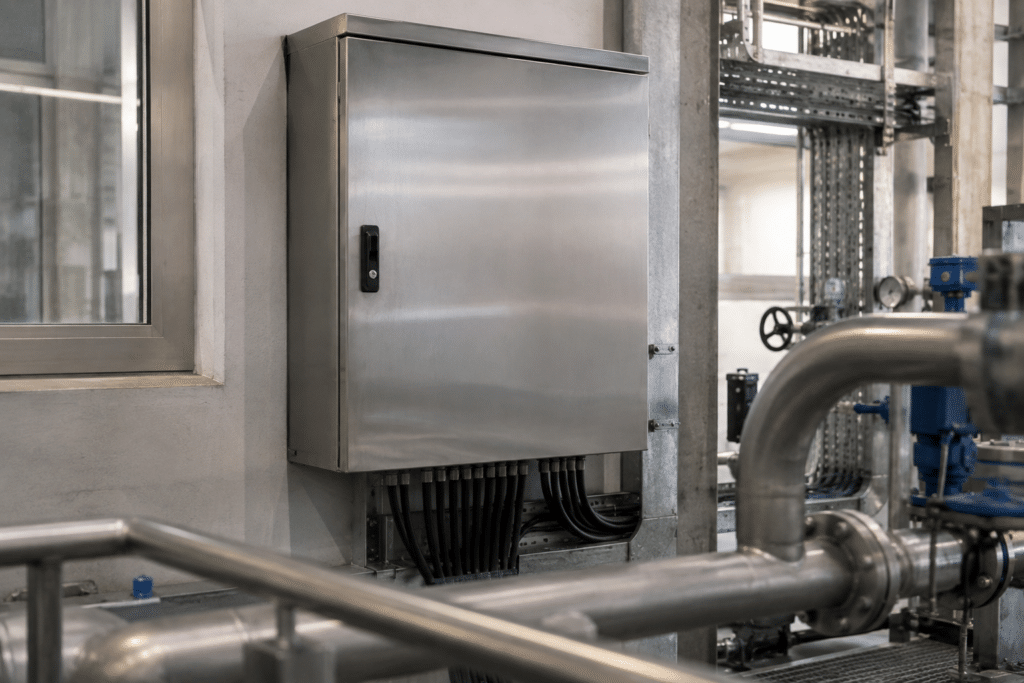
A high IP rating doesn’t automatically make an enclosure the right choice for every environment, and choosing a higher rating than necessary only drives up the cost of the installation without adding any real value.
In this guide, we cover how to read an IP code, what the most common ratings mean and, above all, what the IP rating isn’t telling you about your electrical enclosure.
What is the IP protection rating and how do you read it
The IP (Ingress Protection) rating is a classification system defined by the international standard IEC 60529 that indicates the level of protection an electrical enclosure offers against two independent factors: the ingress of solid objects and dust, and the ingress of water.
A full IP code consists of the fixed letters IP followed by two digits: the first indicates protection against solids (from 0 to 6) and the second, protection against water (from 0 to 9K). When one of the two digits hasn’t been evaluated or isn’t relevant to the case, it’s replaced with an X: for example, IPX7 indicates that only protection against water has been certified.
First digit: protection against solids (0–6)

Second digit: protection against water (0–9K)

The most common ratings for electrical enclosures and when to choose each one
- IP54: intgeneral indoor use, technical offices or light industry with no direct exposure to water jets.
- IP65: the most common standard for industrial installations. Protects against total dust ingress and moderate water jets.
- IP66: recommended for outdoor use, coastal areas or frequent higher-pressure washdowns.
- IP67: necessary when there’s a risk of occasional flooding or brief submersion of the enclosure.
- IP68: for equipment that’s permanently submerged or in extreme sealing conditions.
The most common mistake: thinking a high IP rating makes up for poor material quality
This is probably the most widespread misunderstanding when specifying an electrical enclosure. The IP rating certifies the enclosure’s sealing at the moment of testing, but it says nothing about how the enclosure material will hold up over time against corrosion, chemical agents or salt exposure.
An IP66 enclosure made of painted steel may perform its function perfectly in the first year. But if it’s exposed to constant humidity, harsh cleaning products or a salty environment, the coating can start to deteriorate over time, and with it, the real protection the enclosure provides, even though the original IP rating remains the same on paper.
That’s why, in demanding environments, the question shouldn’t be just “what IP rating do I need?” but rather “what IP rating and what material do I need for that protection to hold up over time?” In these cases, stainless steel electrical enclosures are the option that most often avoids this kind of progressive deterioration, precisely because their corrosion resistance doesn’t depend on a surface finish that can get damaged.
Recommendation table by environment type

This table is for guidance only: the final choice should always be adapted to the actual conditions of each installation.
Frequently asked questions about IP protection ratings
What’s the difference between IP65, IP66 and IP67?
They all share the digit 6 as the first number (dust-tight). The difference is in the second digit: IP65 protects against moderate water jets, IP66 against more powerful jets, and IP67 against temporary immersion.
Does IP67 protect against pressurized water jets?
Not necessarily. Immersion certification (7 or 8) doesn’t automatically imply protection against jets (5 or 6). If both are needed, look for a dual rating, such as IP66/IP68.
What IP rating do I need for outdoor use?
IP65 at minimum, and typically IP66 if there’s exposure to heavy rain, frequent washdowns or proximity to the sea.
Does the IP rating also indicate impact resistance?
No. Mechanical resistance to impacts is measured with the IK rating (EN 62262 standard), a separate spec from IP that’s also worth considering in environments with a risk of impacts.
At Volthree, we help you specify the right protection rating and material for each installation, without over-specifying or falling short.