
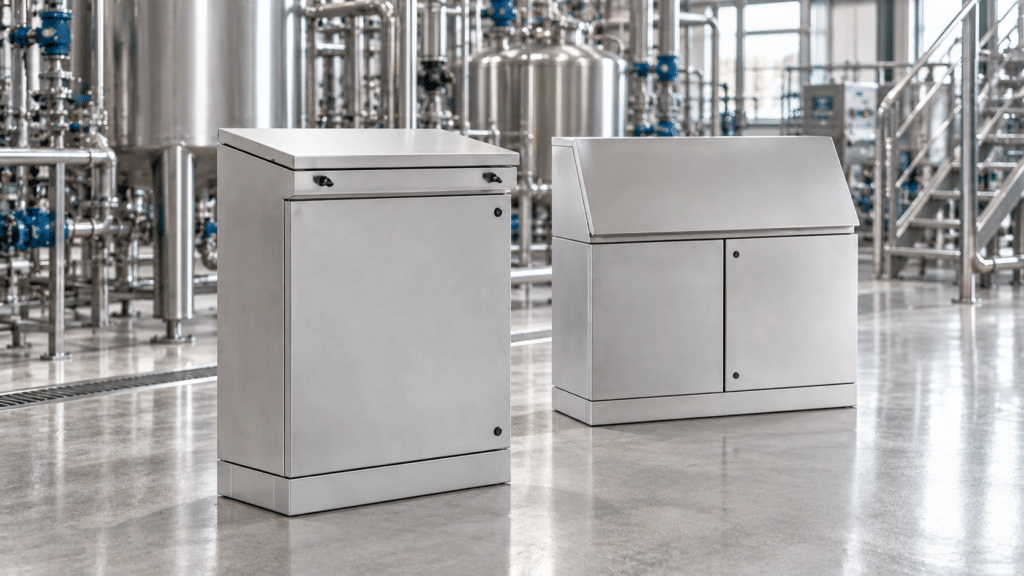
Any one of these factors alone already calls for a well-specified enclosure. Together, they turn the choice of electrical cabinet into a decision that can determine the reliability of an entire installation.
This article reviews what should be required of an electrical enclosure in the naval and offshore sector, and which aspects are often overlooked when specifying one.
Why the marine environment is one of the most demanding for an electrical enclosure
Constant salinity
Salt present in the air and, in many cases, in the work process itself, is one of the most aggressive corrosive agents an electrical enclosure can encounter. Unlike a one-off exposure, in a maritime environment salinity is a permanent condition, which accelerates any corrosion process in materials not built to withstand it.
Humidity and Condensation
The combination of high ambient humidity and temperature swings — especially between day and night, or between the interior and exterior of a vessel or platform — encourages condensation inside electrical enclosures if it isn’t properly managed, with the risks that entails for the components housed inside.
Vibration
On board a ship or on a platform with heavy machinery running continuously, vibration is a permanent working condition, not an occasional exception. A poorly secured enclosure, or one with a weak structural design, can suffer fatigue over time, in addition to compromising the fastening of internal components.
The Material: Why AISI316L stainless steel is the benchmark in this environment
Given the combination of constant salinity and humidity, AISI316L stainless steel electrical enclosures are, generally speaking, the reference option in maritime and port installations, compared with AISI304, AISI304L stainless steel, or even painted steel, whose surface finish can degrade with prolonged salt exposure.
AISI316L stainless steel is the ideal material for electrical enclosures in marine environments because its molybdenum alloy and low carbon content neutralise the aggressive attack of chlorides and salinity. Molybdenum, at a proportion of 2% to 3%, gives it dramatically improved resistance to the pitting and crevice corrosion caused by salt fog. And the low carbon content (under 0.03%) provides greater resistance to oxide formation at welded joints.
Because it doesn’t rust or degrade under constant humidity, the enclosure keeps its seals and mechanical properties intact, ensuring the protection of the electrical equipment inside.
Mechanical resistance (IK Rating): The factor that’s often overlooked
Beyond the IP rating against solids and water, in environments with vibration or impact risk it’s worth paying attention to the IK rating, defined by the EN 62262 standard, which measures an enclosure’s resistance to mechanical impacts on a scale from IK00 to IK10.
It’s common to focus entirely on the IP rating and overlook IK, but an enclosure with excellent sealing and insufficient mechanical resistance can suffer structural damage in an environment with constant vibration or the risk of accidental impacts — typical of port areas or heavy machinery work sites.
When ATEX marking comes into play
In certain areas of the naval and offshore sector — oil platforms, fuel storage areas, or facilities where potentially explosive atmospheres can occur, the electrical enclosure may need to carry ATEX marking, in accordance with the European directive governing equipment intended for explosive atmospheres.
Not all maritime installations require this marking: it depends on whether zone classification for explosive atmosphere risk applies at the specific point where the enclosure is installed. This classification must be determined by the project manager or a technician specialised in the specific installation, since applying ATEX where it isn’t needed adds cost without adding value, and failing to apply it where it is needed poses a safety risk.
Typical applications in the sector
- Ports: electrical distribution panels, lighting and control equipment permanently exposed to salinity and humidity.
- Vessels: electrical enclosures subject to constant vibration and typically limited installation space.
- Offshore platforms: a combination of extreme salinity, vibration and, in many cases, the need for ATEX classification depending on the zone.
Frequently asked questions about electrical enclosures in the naval and offshore sector
What steel is recommended for electrical enclosures in maritime environments?
Generally speaking, AISI316L stainless steel is the reference option against constant salinity. The specific grade should be confirmed with the supplier based on the salt exposure level of each installation.
Is ATEX marking mandatory on offshore platforms?
Not universally. It depends on whether zone classification for explosive atmosphere risk applies at the specific installation point. This must be determined by a specialised technician for each project.
What IP rating does an electrical enclosure need at a port?
IP65 as a minimum, and typically IP66, since it’s an outdoor environment with salinity and, in many cases, washdowns or exposure to water jets.
Why is the IK rating important in this sector?
Because constant vibration and the risk of accidental impacts, common in port environments and on board vessels, can damage an enclosure with good sealing but insufficient mechanical resistance.
At Volthree, we supply stainless steel electrical enclosures adapted to the demands of the maritime environment. If you have a project in the naval or offshore sector and need help specifying the right enclosure, with our team.