
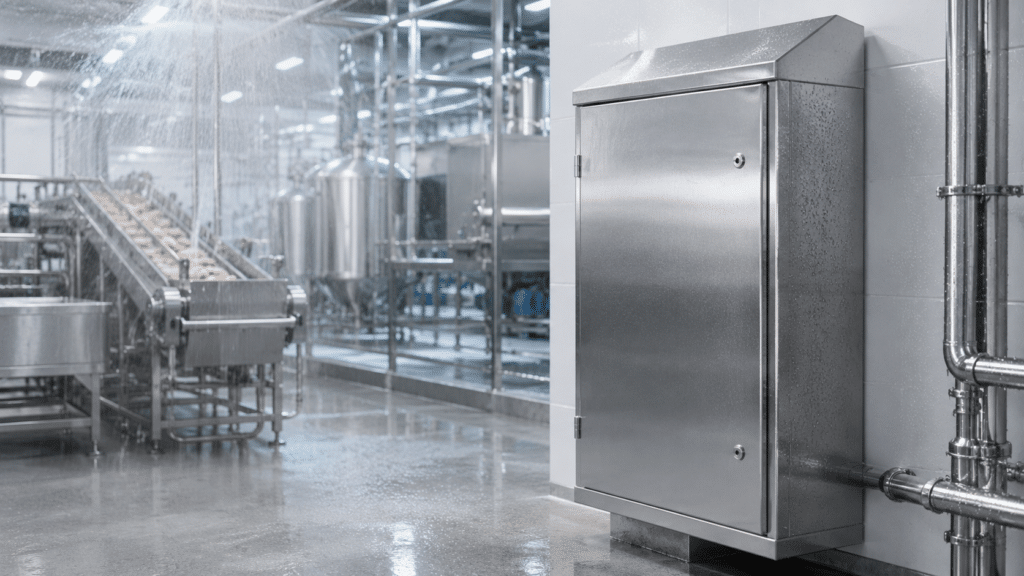
A poorly specified enclosure doesn’t fail “if” but “when,” and when it does, it fails at the worst possible moment: in the middle of a production line, with the added cost of unplanned downtime and, in many cases, direct implications for food safety.
This guide is designed for those who already understand the problem and need to decide: what material, what protection rating, and what regulations apply to an electrical enclosure intended for a food environment, and why cutting corners on the initial specification almost always costs more in the medium term.
Why the food industry demands a different electrical enclosure
No other sector combines constant humidity, extreme temperatures (from freezer rooms to cooking areas), and cleaning cycles with pressurized water and aggressive chemicals so systematically. Added to this is a requirement that doesn’t exist in most industries: the enclosure cannot become a source of contamination. Any deteriorated gasket, any crevice where moisture or organic residue can accumulate, is a hygiene risk, not just an electrical one.
That’s why an enclosure designed for a conventional industrial building —painted steel, IP54, indoor use with no exposure to pressurized water— is simply the wrong specification for a food and beverage plant.
Material: AISI 316L stainless steel is the most common choice
In virtually all processing, washdown, and storage areas of a food facility, AISI 316L stainless steel is the reference standard, not one option among several:
Resistance to CIP/SIP protocols (Clean in Place / Sterilize in Place): these cycles combine hot water, steam, and cleaning chemicals that rapidly degrade less resistant materials.
Resistance to chlorides: AISI 316L incorporates molybdenum in its composition, allowing it to withstand salt, brine, and chlorinated disinfectants common in slaughterhouses, canneries, or dairy plants without developing localized corrosion (pitting).
Sanitary finish: smooth surfaces, no internal right angles, with polished welds that don’t retain residue or promote bacterial growth.
AISI 304L may be sufficient in administrative or technical support areas without direct contact with the process, but as soon as there is exposure to chlorides or intensive cleaning, 304L tends to develop corrosion over time. The cost difference between the two, compared to the cost of premature replacement, means that in most projects 316L is the right decision from day one.
Polycarbonate or GRP polyester may make sense in peripheral, low-demand areas (outdoor technical areas, pump rooms), but they are not suitable for processing or washdown areas, where mechanical strength and compatibility with high-pressure cleaning are decisive factors.
IP and IK ratings: what a food plant really requires
The IP rating (EN 60529 standard) is probably the criterion where the most specification errors occur in this sector, because the difference between two seemingly similar ratings can determine the enclosure’s real service life.

IP65 vs. IP66 vs. IP69K: the distinction that most often gets it wrong
IP65: total protection against dust, resistance to low-pressure water jets. Insufficient in any area with hose-down cleaning.
IP66: withstands high-pressure, high-volume water jets. It’s the reasonable minimum for most of a food plant.
IP69K: specifically designed for cleaning with water at 80–100 bar and temperatures of up to 80 °C. It’s the de facto standard in intensive washdown areas, slaughterhouses, boning rooms, and dairy lines.
As for the IK rating, areas with heavy forklift, container, or personnel traffic —very common in the internal logistics of food plants— justify IK09 or IK10 (up to 20 joules of impact resistance), compared to IK08, which covers a standard industrial environment without that added mechanical risk.
Hygienic design aspects that don’t appear on the datasheet
Beyond material and IP rating, there are construction decisions that make the difference between an enclosure that complies on paper and one that actually performs in a food plant. The roof, for example, should always be sloped rather than flat: a horizontal surface on top of the enclosure accumulates water and residue with every cleaning cycle, and this detail, which seems minor, is often one of the first points flagged by hygiene audits. The same applies to gaskets and cable glands: in an environment with CIP/SIP protocols, any exposed thread or discontinuity in the seal becomes a point where dirt and moisture are retained, which is why hygienic design requires flat cable glands and continuous, uninterrupted gaskets.
Hinges and latches must also be made of stainless steel and, above all, be free of blind spots. Any gap that cleaning cannot reach is, in practice, a microbiological risk point, no matter how correct the overall IP rating is. In cold rooms and freezers, there’s an additional factor that doesn’t exist in a stable-temperature processing area: the thermal shock between that room and adjacent areas generates internal condensation in the enclosure, and it’s worth anticipating this with anti-condensation heaters or controlled ventilation, depending on the case, rather than discovering it once it has already corroded the internal components. Finally, in facilities that handle flour, sugar, or powdered starches, there’s a specific risk of explosive atmospheres that doesn’t depend on the rest of the plant. At those specific points, and only there, the enclosure must comply with the ATEX Directive 2014/34/EU.
Most common mistakes when specifying an enclosure for the food industry
The most common mistake, and the one that most shortens the enclosure’s service life, is confusing IP65 with IP66, assuming that “total protection against dust” also implies resistance to pressure cleaning. It doesn’t, and this confusion is responsible for a large share of premature failures in food plants. Closely related is the mistake of using AISI 304L in areas with chlorides or CIP/SIP cleaning simply because its initial price is lower, without considering that the cost of replacing it after a few years usually far exceeds the initial savings.
Another frequent mistake, and a harder one to diagnose, is failing to anticipate the risk of condensation at the thermal shock point between the processing zone and the cold room; the result is not an obvious failure but progressive internal corrosion and intermittent electrical faults that can take months to trace back to their real cause. Added to this is a planning mistake rather than a material one: sizing the enclosure to the exact limit of current needs, without leaving reserve space for future automation upgrades or new lines, which forces complete replacements as soon as the plant grows. Finally, there’s a focus mistake that affects even technically correct specifications on paper: focusing only on the nominal IP rating and ignoring hygienic design (flat roofs, exposed threads, blind spots), when food hygiene audits assess both.
Frequently asked questions
What electrical enclosure material is mandatory in the food industry?
There is no regulatory requirement that mandates a specific material, but in practice AISI 316L is the de facto standard in processing and washdown areas, due to its resistance to chlorides and CIP/SIP protocols. AISI 304L may be valid in adjacent areas without direct contact with the process or exposure to intensive cleaning.
What IP rating does an electrical enclosure need in a washdown area?
IP69K at a minimum, as it’s the only rating designed to withstand cleaning with water at 80–100 bar of pressure and up to 80 °C, conditions common in the cleaning protocols of slaughterhouses, boning rooms, and dairy plants.
Is an ATEX enclosure necessary in every food plant?
Not throughout the entire facility, but yes in areas where powdered products with a risk of generating explosive atmospheres are handled, such as flour, sugar, or starch. At those specific points, the ATEX Directive 2014/34/EU applies, regardless of the rest of the plant.
What’s the difference between an enclosure for a processing zone and one for a cold room?
Both typically require IP66 or higher, but the cold room enclosure also needs specific condensation management resulting from the thermal shock with adjacent areas, which is not a relevant factor in a stable-temperature processing zone.
Do you need help defining the right electrical enclosure for your food plant?
At Volthree, we analyze every line and every zone of your facility to specify the material, protection rating, and hygienic design your process really needs, avoiding overspecification costs and failures from insufficient specification.