
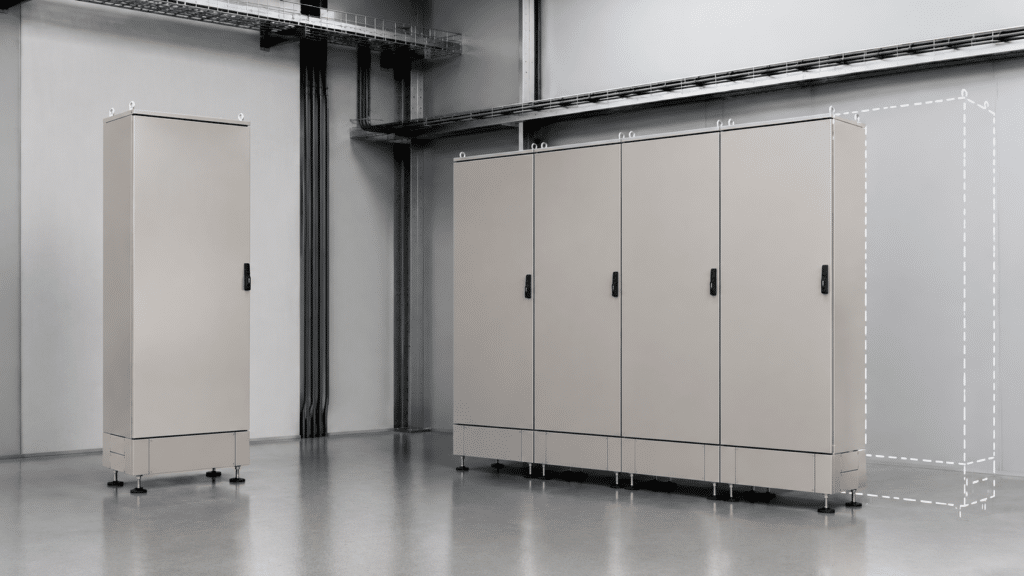
The real difference isn’t size, it’s architecture
A monobloc cabinet is a single enclosure, manufactured as one structural piece. A modular system is made up of independent sections that connect to each other, each with its own function (incoming supply, distribution, motor outputs, control), which can be added, replaced, or reconfigured without dismantling the whole assembly. The difference isn’t cosmetic: one is designed for a fixed need, the other for a need that is expected to change.
Facilities with planned or likely expansions. If the plant has a growth plan (new production lines, progressive automation, new equipment), a modular system allows sections to be added without replacing the entire panel or shutting down the whole facility during the expansion. With a monobloc, any expansion beyond the initial capacity requires replacing the entire cabinet.
Section-by-section maintenance without stopping the whole line In plants with continuous production, being able to isolate and replace a specific section of the panel (for example, a motor’s control section) without disconnecting the rest of the facility reduces downtime during a fault or scheduled maintenance. In a monobloc, working on one part of the panel usually means disconnecting the entire assembly.
Projects with design-phase uncertainty. When a project is specified before the final number of circuits or equipment to be connected is finalized (common in new construction with multiple contracting phases), a modular system allows work to begin with the necessary configuration and sections to be completed as the rest of the project is defined.
Installations with complex or custom configurations. Beyond future growth, the modular system is also chosen when the current installation requires a complex or highly specific configuration—such as various combinations of inputs, distribution, controls, and motor outputs that do not fit well into a factory-sealed design. Because it is assembled from independent sections, the modular system allows the panel to be adapted to the exact layout required by each installation, offering a level of design and assembly flexibility that a monoblock unit—conceived as a single piece—cannot provide.
When a monobloc is the right decision
Facilities with fixed and stable needs. If the number of circuits, power, and configuration won’t change over the facility’s foreseeable service life, paying the extra cost of a modular system provides no real benefit: you’d be paying for flexibility that will never be used.
Limited space. Modular systems need coupling clearances between sections and, in some designs, additional space for connecting elements. In technical rooms with very tight space, a well-sized monobloc from the outset can be more space-efficient.
Tight budget with no real growth forecast. A modular system has a higher initial cost per section than an equivalent-capacity monobloc. Without a reasonable forecast of expansion, that extra cost is never recovered.

One thing that doesn’t depend on the type of architecture: material and protection rating
In both monobloc and modular cabinets, the material (painted steel, AISI 304L, AISI 316L) and the IP/IK protection rating are specified the same way, based on the installation environment: humidity, chemical agents, mechanical impact risk. The choice between modular and monobloc is a panel architecture decision; the choice of material and protection is an environment decision. They are independent, and it’s worth not mixing both criteria in the same purchasing conversation, since they lead to different questions and, sometimes, to different suppliers within the same order.
Frequently asked questions
How do I know if I need a modular system or a monobloc cabinet?
It depends on whether the facility will grow. If there’s an expansion plan for the next 3-5 years, even if not fully finalized, a modular system allows sections to be added without replacing the entire panel. If the number of circuits and the configuration will remain stable over the facility’s service life, a monobloc serves the same function at a lower cost.
Does a modular system allow maintenance without stopping the entire production line?
Yes, that’s one of its main advantages. Because it’s divided into independent sections, a specific section (for example, a motor’s control) can be isolated and replaced without disconnecting the rest of the panel. In a monobloc cabinet, an intervention usually requires disconnecting the entire assembly.
How much additional space does a modular system need compared to a monobloc?
Modular systems require coupling clearances between sections and, depending on the design, additional space for connecting elements. If the technical room has very tight space, a well-sized monobloc from the outset can make better use of the available surface area.
Is it worth paying more for a modular system if I have no plans to expand the facility?
No. The initial cost per section of a modular system is higher than an equivalent-capacity monobloc, and that difference is only recovered if the facility is actually expanded. Without a reasonable growth forecast, that extra cost is never recovered.
Do the material and IP/IK protection rating change depending on whether the cabinet is modular or monobloc?
No, these are independent decisions. The material (painted steel, AISI 304L, AISI 316L) and the IP/IK rating are specified according to the installation environment (humidity, chemical agents, impact risk), regardless of whether the panel’s architecture is modular or monobloc.