
The confusion doesn’t help when, on top of that, “junction box” shows up in the same order alongside terms like connection box or terminal box, which are often used as synonyms without being fully interchangeable. Before getting into materials and protection ratings, it’s worth clarifying this, because a poorly specified order at this stage usually ends up in last-minute machining on site or, worse, in a box that can’t withstand the environment it was bought for.
What a junction box is and what function it serves in an industrial installation
A junction box is the point in an installation where an electrical circuit splits into several, or where cable runs are spliced without needing to go through a full panel. Its role isn’t to house control gear or protection devices, but to physically shield those connections from the environment: moisture, dust, impacts or, in industrial settings, cleaning chemicals.
This is where the first vocabulary confusion tends to show up. The connection box serves a very similar function, and in practice many manufacturers use both terms interchangeably for the same product. The terminal box, on the other hand, does have a real difference: it includes a terminal strip inside specifically designed to allow for organized, repeatable connections, whereas a junction box can be handled with direct splices if the project doesn’t require that level of organization. If your installation will undergo frequent maintenance or expansions, ordering a terminal box directly instead of a generic junction box saves installation time down the line.
Available materials and when each one makes sense
The material of a junction box isn’t an aesthetic choice or a simple budget adjustment: it’s the decision that determines whether that box will still be doing its job in five years or whether it will need early replacement.
Polycarbonate and fiberglass-reinforced polyester are the most common choice for dry indoor settings and installations without chemical exposure. They’re lightweight, affordable, and resistant enough for a standard industrial environment, but they lose much of their cost advantage as soon as they’re exposed to continuous UV rays without additional protection, or to aggressive cleaning products, where they tend to become brittle over time.
Painted steel remains a reasonable option in indoor industrial buildings without systematic water exposure. The problem, as with any painted enclosure, is that the protection depends on a surface layer: an impact during transport or a seal starting to fail is all it takes for corrosion to spread beneath the paint without it being visible from the outside.
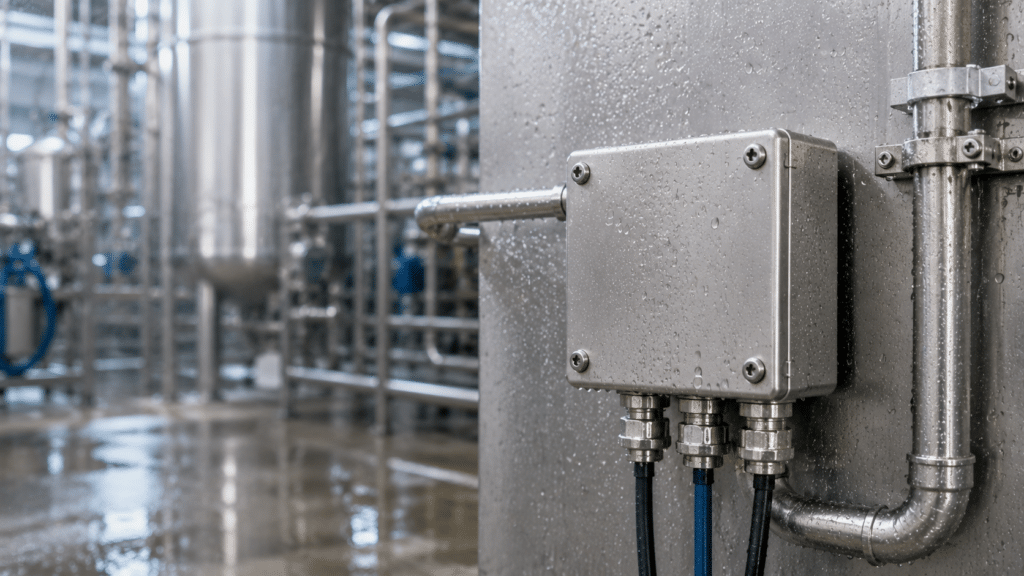
Stainless steel comes into play as soon as the junction box will be exposed to water, hose-down cleaning, chlorides, or hygienic design regulations, as is the case in the food, pharmaceutical, or water treatment industries. It’s worth keeping in mind here that if the rest of the electrical panel in the installation has already been specified in stainless steel enclosures, keeping the same material for the junction boxes isn’t just a matter of aesthetic consistency: it also prevents the galvanic couple that forms when combining steels of different composition within the same grounding circuit — a problem that’s rarely detected until it has already begun corroding the connections.
IP rating: the criterion most often gotten wrong when buying a junction box
If the material determines long-term durability, the IP protection rating determines whether the box will hold up to the installation’s real day-to-day conditions, and this is where the most common, and most costly, mistake is made.
In dry indoor areas, with occasional dust exposure and no direct washing, an IP54 or IP55 rating is usually enough. The significant jump comes when the box will be outdoors or near a washdown area: there, the reasonable minimum is IP66, which withstands high-flow water jets, as opposed to IP65, which only covers low-pressure jets and is by far the rating most often confused with higher protection levels when ordering. And in installations where the junction box will undergo cleaning with high-pressure, high-temperature water (slaughterhouses, cutting rooms, dairy lines), the de facto standard is IP69K, the only rating specifically designed for those conditions.
This hierarchy of IP ratings, and the specific confusion between IP65 and IP66, is the same one that applies to any electrical enclosure in a food-industry setting, and it’s worth keeping in mind regardless of whether you’re specifying a small junction box or a full cabinet.
Cable glands and cable entry: the detail that compromises the rated IP
There’s one point that rarely shows up in the technical datasheet yet is responsible for a large share of premature failures: the cable gland. A box with a factory-certified IP66 rating loses that protection level the moment a cable gland of the wrong diameter is fitted for the cable’s cross-section, leaving a gap through which moisture can enter even though the rest of the box is perfectly sealed.
This is especially relevant in installations where a future expansion is planned: it’s common to leave a “spare” cable entry capped with a generic plug that doesn’t offer the same level of sealing as a correctly sized cable gland. If that entry point is going to be used within the next few months, it’s worth specifying the final cable gland from the first order rather than improvising on site when the time comes.
Size and number of entries: sizing for today and for tomorrow
The mistake of sizing exactly to current needs isn’t exclusive to large electrical cabinets: it also happens, and even more frequently, with junction boxes, precisely because their unit cost is low and oversizing doesn’t seem to be worth it. But a junction box that turns out too small as the installation grows forces a full replacement of the unit — including rewiring everything that was already connected — when leaving one or two additional entries from the start would have cost only a fraction of that work.
Frequently asked questions
What’s the difference between a junction box and a connection box?
In commercial practice, both terms are often used as synonyms for the same type of product. The real difference appears when compared to a terminal box, which does include an internal connection strip designed to make maintenance and expansions easier.
Do I need a stainless steel junction box if it’s indoors?
Not necessarily. In dry indoor settings without chemical exposure, polycarbonate or painted steel are usually sufficient. Stainless steel becomes relevant as soon as there’s constant moisture, cleaning with chemical products, or hygienic design regulations involved.
What’s the minimum IP rating required for an outdoor junction box?
IP66 at minimum, since it withstands high-flow water jets. IP65, despite seeming similar, only covers low-pressure jets and isn’t sufficient against heavy rain or hose-down cleaning.
Can the same box be used for low voltage and for signal or data?
It’s preferable to keep them separate whenever the project allows it, to avoid electromagnetic interference between power cabling and signal cabling, even though the IP rating and material can be the same in both cases.
Do you need help specifying the right junction box for your installation?
At Volthree we help specify the material, protection rating, and cable entry system your project needs, whether it’s a single junction box or part of a complete stainless steel electrical panel.