
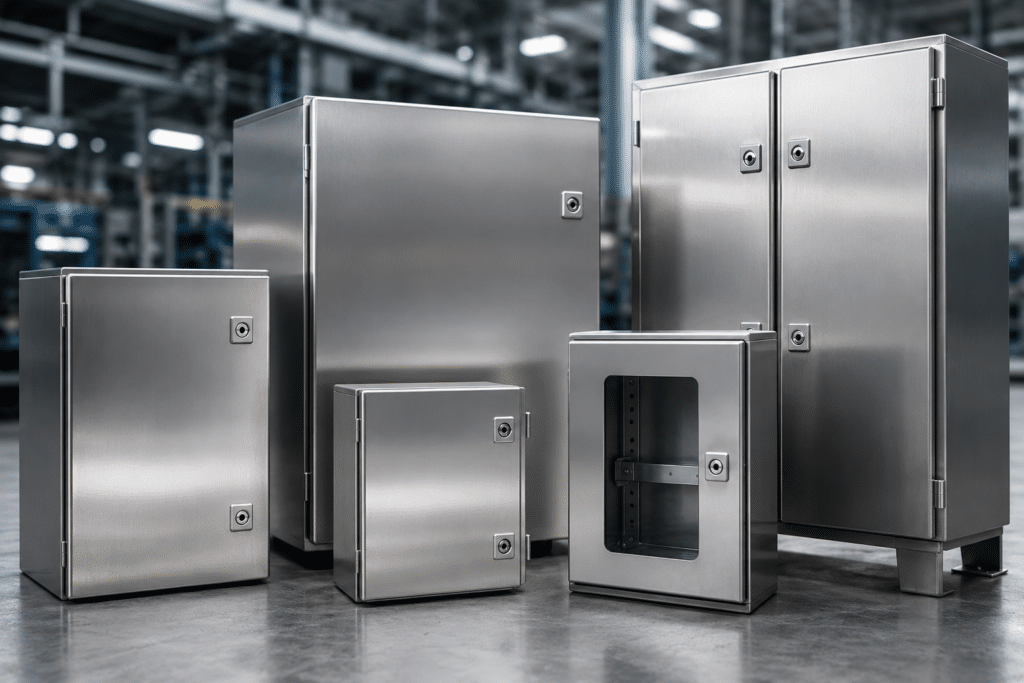
What is an electrical enclosure?
An electrical enclosure is the protective structure that houses and isolates electrical and electronic equipment from external agents such as dust, humidity, mechanical impacts, and chemicals. Its function is twofold: to protect the components installed inside—control panels, variable frequency drives, automation systems, and protection systems—and to act as a physical barrier against accidental contact with live parts.
Difference with the electrical cabinet: the enclosure is the physical container; the electrical cabinet is the complete set that includes the enclosure plus all the components installed inside.
Materials for electrical enclosures: which one to choose depending on the environment
The material determines the durability, maintenance, and performance of the building envelope over time. The following table summarizes the main options and their most common applications:
AISI 304L and AISI 316L stainless steel
It’s the benchmark in demanding environments: high corrosion resistance, easy cleaning, and a long service life. AISI 304L covers most wet and food-grade applications. AISI 316L, with molybdenum in its composition, is ideal for environments with chlorides, acids, or highly aggressive chemicals, such as marine environments, the chemical industry, and intensive disinfection systems.
Painted steel
A balanced solution for interiors with controlled conditions: industrial buildings, technical rooms, or logistics centers where there is no continuous exposure to humidity or corrosive agents. Its limitation is that the coating may deteriorate if the environment is more aggressive than anticipated.
Polyester (GRP) and polycarbonate
Engineering plastics are a viable alternative for outdoor installations, telecommunications infrastructure, or applications where weight is a critical factor. They are non-corrosive, withstand UV exposure well, and offer up to IP66 protection. Polycarbonate also allows for the incorporation of transparent windows for visual monitoring without opening the enclosure. Its main weakness is its lower mechanical strength compared to steel.

What type of electrical enclosure does each type of installation require?
Industrial warehouse or interior technical room
Painted steel with IP54–IP65 and IK08 ratings. An efficient solution when the environment does not present significant humidity or exposure to corrosive agents.
Food and beverage industry
AISI 316L stainless steel with a minimum IP66 rating, IP69K in washdown areas. Cleaning cycles with pressurized water and aggressive chemicals rule out virtually any other material. IK09 or IK10 rating for high-traffic areas.
Chemical and pharmaceutical industry
AISI 316L stainless steel is used as a reference, with specific evaluation of chemical resistance against the agents inherent to the process. In areas with a risk of explosive atmospheres, the enclosure must be certified according to ATEX Directive 2014/34/EU.
Outdoor facilities
IP65 minimum, IP66 or IP67 in coastal environments or areas with frequent rainfall. Polyester GRP or stainless steel are the most suitable materials, as both withstand UV radiation and prolonged temperature fluctuations without degrading.
Water Treatment and Sanitation
AISI 316L stainless steel with IP66 or higher, due to the common presence of corrosive gases such as hydrogen sulfide (H₂S) and chemicals used in water treatment. IK09 or IK10 when access is difficult or there is a risk of mechanical impact.
IP and IK ratings: how to interpret them correctly
The IP rating (EN 60529 standard) indicates the level of protection against solids and liquids using two digits: the first measures dust resistance (0–6) and the second water resistance (0–9K). The IK rating (EN 62262 standard) measures resistance to mechanical impacts in joules: IK08 is equivalent to 5 J and covers most standard industrial environments; IK10 reaches 20 J and is recommended for high-traffic or intensive use areas.
A common mistake is confusing IP65 with IP66: both offer complete protection against dust, but only IP66 withstands high-pressure water jets. In a food processing plant with intensive cleaning, that difference can determine whether the enclosure lasts five years or one.
Frequently asked questions about electrical enclosures
What is the most common mistake when choosing an electrical enclosure?
Prioritizing price over actual working conditions. A poorly specified enclosure often costs much more in the medium term, between repairs, replacements, and unplanned production downtime, than the initial price difference between a suitable and an inadequate solution. The second most common mistake is not leaving enough space for future expansions: sizing to the limit forces costly modifications when the facility grows.
What is the difference between IP65, IP66 and IP69K?
All three offer complete protection against dust, but differ in water resistance. IP65 withstands low-pressure jets. IP66 withstands high-pressure jets and high flow rates. IP69K is designed for cleaning with water at 80–100 bar and temperatures up to 80 °C, and is the benchmark in industries with strict hygiene protocols, such as food and pharmaceuticals.
When is AISI 316L stainless steel essential?
When the environment combines high humidity with aggressive chemical agents such as chlorides, acids, intensive disinfectants, or marine environments, AISI 316L is practically the industry standard in the food industry, where CIP/SIP cleaning protocols make it the preferred choice. In environments with chlorides present in the air, AISI 304L can develop localized corrosion over time, making AISI 316L the correct specification.
What regulations govern electrical enclosures in Spain?
The primary framework is the Low Voltage Electrotechnical Regulation (REBT) and its supplementary technical instructions. At the product level, the relevant standards are EN 60529 for IP ratings, EN 62262 for IK ratings, and IEC 62208 for general requirements for low-voltage enclosures. In areas with a risk of explosive atmospheres, the ATEX Directive 2014/34/EU also applies.
Do you have questions about which electrical enclosure your installation needs?
At Volthree we analyze each project to recommend the most suitable solution according to the environment, the level of protection required and the applicable regulatory requirements.