
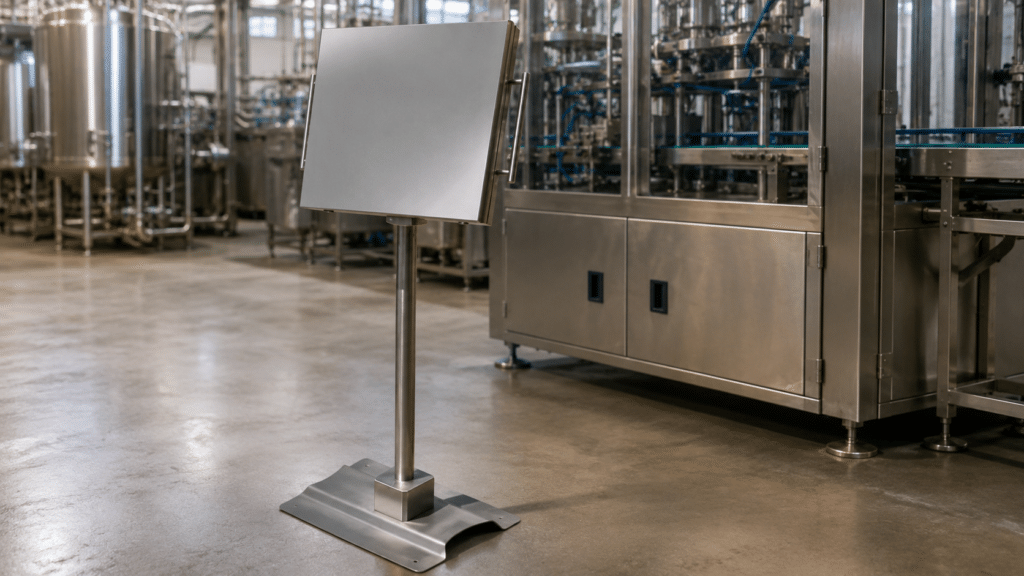
Why the console or control desk needs its own specification
It is common to assume that a remote control station inherits the protection rating of the main cabinet to which it is connected. This is not the case. The cabinet is usually situated in a more sheltered location, whereas the console is located at the operator’s workstation, where it is exposed to direct splashes, tool impacts, contact with carts, and constant handling. Treating it merely as a minor extension of the cabinet, rather than as a component with its own specific requirements, is the root cause of most premature failures in this type of equipment.
IP rating: tightness of the control station
According to EN 60529 and ISO 20653, the first IP digit covers protection against solids and the second against water. For consoles and control desks in industrial environments:
- IP54/IP55: dry indoor environments, occasional dust, no direct washing of the control station.
- IP65/IP66: low- or medium-pressure hose; the reasonable minimum if the work area is cleaned regularly.
- IP69K: high-pressure, high-temperature water from any direction; mandatory if the operator cleans the workstation itself using a pressure hose (common in cutting rooms, dairy processing lines, or slaughterhouses).
IK rating: the often-overlooked detail in a workplace
Unlike the cabinet, the console is exposed to constant impacts: tools placed on top, scraping containers, and the movement of carts near the workstation. The EN 62208 standard defines the IK rating, ranging from IK00 (no protection) to IK10 (resistance to a 20-joule impact). For a control station located in a passageway or next to a line involving load handling, IK08 (5 joules) is the reasonable minimum; in areas with heavy cart or container traffic, it is advisable to upgrade to IK09 or IK10.
Mounting type: column, tabletop, or flush-mount
The choice of mounting configuration determines both the console’s dimensions and the required cable length; therefore, it is best to decide on this before requesting a quote rather than during installation. A pedestal-mounted unit is the most common choice for production lines, as it allows for adjustable working height and secure floor anchoring. A desktop console is better suited for fixed workstations next to a main control panel, typically featuring a tiltable panel to improve the operator’s visual ergonomics. Finally, wall or bench mounting makes sense when floor space is limited and workstation mobility is not required.

Before specifying, the actual available space and the distance between the control station and the main panel must be measured; this determines the required cable length and the type of cable gland needed.
Compatibility with the existing dashboard
Most orders do not start from scratch but rather expand or replace a component in an existing control panel, and this is where unforeseen issues often arise. Before requesting a quote, it is advisable to clarify the voltage and signal type handled by the control components to be integrated (push-buttons, selector switches, pilot lights, HMI screens), the diameter and type of cable glands required to maintain the overall IP rating after wiring, and the compatibility of mechanical cutouts for HMIs or touchscreens—especially when replacing a component from a different manufacturer. Orders placed without resolving these three details often require additional on-site machining, which delays commissioning and can compromise the original IP rating.
When the ATEX classification comes into play
If the control station is to be installed in an area classified as having a potentially explosive atmosphere—such as those containing gases or solvents in the chemical industry, or combustible dusts like flour, sugar, or starch in the food industry—the console requires ATEX marking in accordance with Directive 2014/34/EU. This marking must specify the equipment group (II, for surface use), category (2 or 3), atmosphere type (G, D, or GD), and zone (1/21 or 2/22). This information is derived from the plant’s own zone classification study rather than from the console manufacturer; therefore, it is advisable to have this determined before initiating commercial discussions, as not all models within a product range are certified for ATEX zones.
Customization common in industrial projects
Orders for consoles and control desks rarely involve off-the-shelf catalog products. Typically, the layout of push-buttons and indicator lights is adapted to the client’s specific electrical schematic, and the front panel angle is selected based on whether the operator works standing or seated. When consoles and desks are intended for food processing or pharmaceutical areas, the same hygienic design criteria required for enclosures are applied: continuous welding, a sanitary finish, no flat tops where water can pool, and no exposed threads or inaccessible areas that cannot be cleaned.
Before requesting a quote
It is advisable to have these six details settled before making initial contact with the manufacturer: the IP rating based on the workstation’s cleaning method; the IK rating based on the location’s impact risk; the mounting type and available floor space; the list of control components to be integrated; the distance to the main panel and the type of cable entry used; and the ATEX zone classification, if there is a risk of an explosive atmosphere. Resolving these six points beforehand drastically reduces the time between the quote and delivery, as it avoids rounds of questions and specification changes mid-production.
At Volthree, we design and manufacture custom stainless steel control desks and consoles, integrated with either existing or newly installed electrical panels. If you have a project underway, we can help you define the complete technical specifications before providing a quote.